
Tiger Exchange Terms and Conditions — Clear Bet Rules, Settlement, 18+
Before your first stake, Tiger Exchange asks you to accept a rulebook that fits in five lines: an age of 18+ with a base in India, a single ID per person, settlement on the officially declared result, payments only through your own named account, and suspension for duplicate IDs.
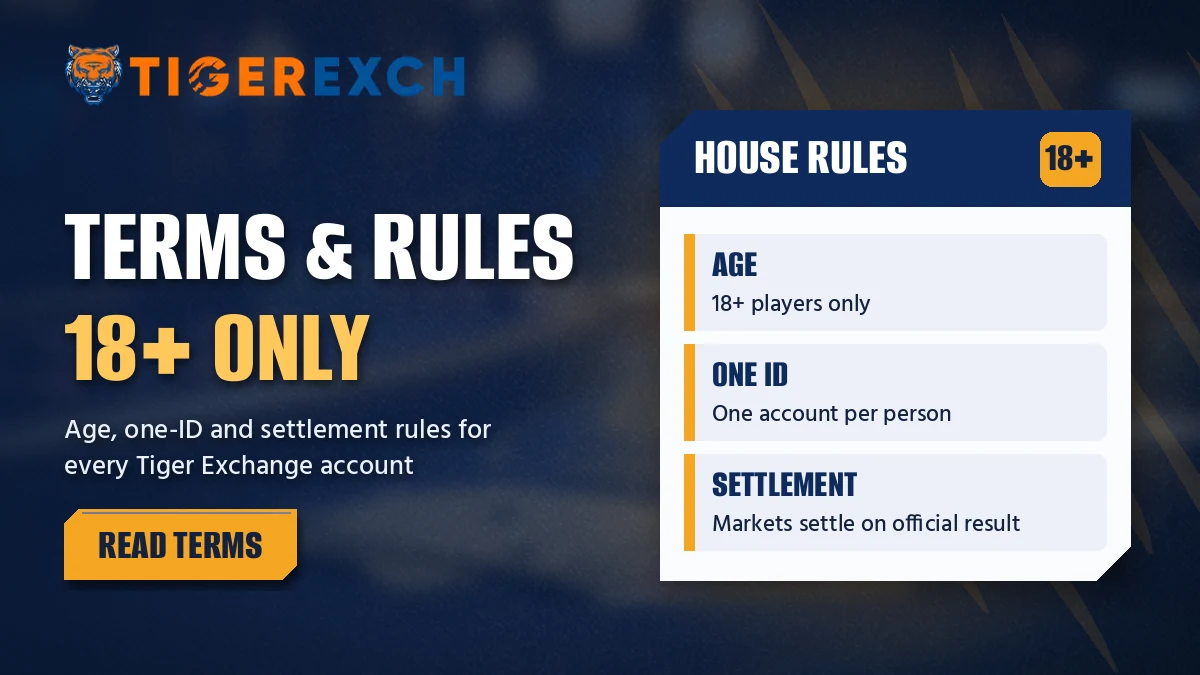
Tiger Exchange Terms: Clear Age and One-ID Rules for India
One KYC document does three jobs on Tiger Exchange. It puts a date of birth on file (18 or older), an Indian address, and the legal name that every later payment gets compared with. The desk usually reads it just before a first payout, so a mismatch shows up then, not at signup.
Then there is the one-person rule, which is simpler than it sounds: one human, one Tiger Exchange ID. That single ID already opens on every Tiger Exch address (the address can change, your account does not), so a second login never solves anything.
Tiger Exchange Bet Rules Based on the Real Declared Result
Most disputes on Tiger Exchange start after the last ball. Or after the rain.
- Declared result counts. Tiger Exchange settles each market on the outcome published by the official body that runs that sport, not on a TV graphic, a score app or a screenshot someone forwards.
- Abandoned means void. When a match is called off without a result, open Tiger Exchange bets on it are voided and the stake goes back to your balance.
- Unless it was already decided. A market whose outcome was fixed before play stopped keeps that result; the abandonment does not undo it.
Rule three is the one people forget. Picture a fancy line that finished at the 20th over, then weather wipes out the rest of the game: that line was settled on real play, so Tiger Exchange lets it stand, while the match-odds bet on the same fixture is returned in full.
Tiger Exchange Rules for Safe Same-Name Deposits and Withdrawals
Whose name is on the payment? For Tiger Exchange the answer has to be yours, in both directions.
| Direction | What Tiger Exchange accepts | What gets declined |
|---|---|---|
| Deposit | UPI, IMPS or bank transfer from an account in your KYC name | A relative's or friend's UPI handle |
| Withdrawal | Bank or UPI in the same name as the Tiger Exchange ID | Any payee whose name does not match |
Shared family accounts are where this trips people up, roughly nine times in ten.
Tiger Exchange Suspension Policy and the Latest Version of These Rules
Open a second Tiger Exchange ID, or a third, and the one-person rule is broken; the desk suspends all the linked accounts, not merely the newest one.
Terms change too. When Tiger Exchange revises these terms and conditions, the updated text replaces this page, and carrying on with your account afterwards counts as accepting the new wording. Reading it again every few months is probably sensible if you play often. What the desk stores about you while the account is open is set out in the Tiger Exchange privacy policy.
- tiger exchange terms and conditions
- tiger exchange rules
- tiger exchange bet rules
- tiger exchange void bet rule
- tiger exchange age limit
- tiger exchange multiple id
- tiger exch settlement rules
- tigerexch terms
Tiger Exchange Rules in One Clear List
Anyone searching Tiger Exchange terms and conditions, Tiger Exchange rules or Tiger Exchange bet rules lands on the same short list of account commitments, all on one page.
- Eligibility: 18+ and based in India, confirmed through KYC.
- One Tiger Exchange ID per person, valid on every Tiger Exch address.
- Settlement follows the result declared by the sport's official body.
- Abandoned matches void open bets unless a market had already settled.
- Deposits and withdrawals only through accounts in your own name.
- Multiple IDs lead to suspension of every linked Tigerexch account.
The newest version of the Tiger Exchange terms is always the one printed here.